halaltravelpal.com
97%
Halaltravelpal
0%

March 27,2026

This 15th Century Fleet Carried 30,000 People Across the Ocean

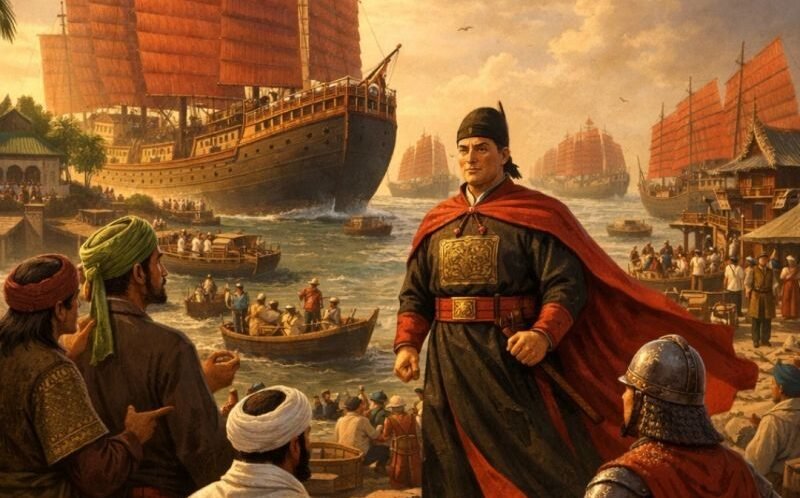
Imagine standing on the shore of Melaka in the 15th century.

On the horizon, you don’t see one ship.
You see hundreds.

Massive wooden vessels moving in formation. Flags raised. Crews shouting orders.

This wasn’t a trading boat arriving quietly.

This was a fleet of around 300 ships carrying 20,000 to 30,000 people.Sailors. Soldiers. Diplomats. Scholars.

Entire floating communities crossing the Indian Ocean.

At a time when most of the world travelled in small, fragile vessels, this scale was almost unimaginable.

And leading it was a Muslim admiral from China.

Not searching for new lands. But building connections between ports like Malacca, Java, and the wider Muslim world.

You’ve heard of Ibn Battuta. But probably not this Chinese admiral who travelled across the Muslim world 600 years ago, and is widely respected in parts of Southeast Asia.

His name was Zheng He, also known as Cheng Ho (Indonesian/Malay usage) and Ma He (his birth name) reflecting how different regions remember him.

Born into a Muslim family, he rose to become one of the most powerful naval commanders in history.

Between 1405 and 1433, he led a series of documented 15th century naval expeditions, strengthening trade and diplomatic ties between China and key ports like Malacca and Java.

Long before today’s travel routes, he was already linking parts of the Muslim world.

What’s interesting is where his legacy still exists today.

In hashtagMelaka (hashtagMalaysia), you’ll find cultural centres and references linked to his visits. In hashtagNanjing (hashtagChina), his tomb still stands. In hashtagSemarang (hashtagIndonesia), the Sam Poo Kong complex and mosques named after him reflect a deep historical connection.

We often focus on halal food and prayer spaces when we travel. But there’s another layer we’re missing.
History. Identity. Connection.

Zheng He wasn’t just an explorer.
He was a bridge between civilizations.

Next time you travel, look for stories like this. They are everywhere. Just not always obvious.

5 2 votes
Article Rating
Subscribe
Notify of
guest
0 Comments
Oldest
Newest Most Voted
Inline Feedbacks
View all comments