halaltravelpal.com
97%
Halaltravelpal
0%

The Hidden Philosophy Behind the Taj Mahal’s Design

Australia’s Muslim Cameleers

Angelica Hazel Toutounji is an Australian freelance travel writer published in The National and other lifestyle platforms. Based in South Australia, she writes about family travel, cultural identity and meaningful destination experiences through a personal lens. A wife, mother and proud Muslim convert, she enjoys exploring different cultures, discovering local cuisines and visiting mosques around the world. She is also the host of the travel podcast The Travel Date, where she shares personal travel stories and conversations about global journeys.

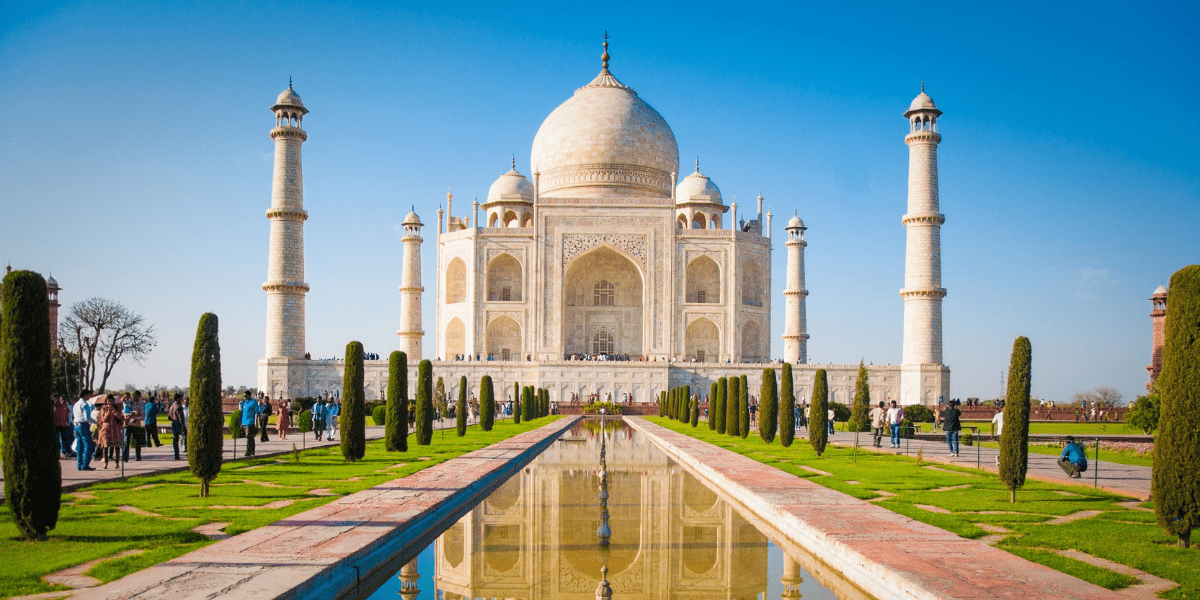
Most people visit the Taj Mahal thinking it’s just a grand love story. But that’s only half the truth.Look closely and you’ll see it was designed as a bridge between the material world and the spiritual realm.

Dr. M A Mufazzal reminds us how often Islamic art is reduced to “beautiful patterns” or “nice geometry,” when in reality it carries one of the deepest philosophical traditions in the world.

When you look closely, Islamic architecture isn’t just design.
It’s a worldview.

At the Taj Mahal, symmetry, light, calligraphy, and proportion weren’t chosen for aesthetics alone. Scholars like Wayne Begley even argue that the entire layout mirrors the Islamic vision of the afterlife, Paradise, Judgment, the Throne, and the eternal journey of the soul.

Every pattern has a purpose.
Every curve tells a story.
Every detail reflects a belief.

What drives this?
Concepts like tawhid (oneness), ihsan (excellence), and barakah (divine blessing).
You see them in the precise geometry, the carved verses, the play of light and shadow, and the gardens designed to reflect peace and harmony.

Islamic art wasn’t trying to imitate nature or showcase the human ego.
It was trying to point beyond both, toward unity, balance, and the spiritual core of existence.

The more you study it, the more obvious it becomes:
Islamic architecture isn’t just built. It’s meant, meant to elevate, to remind, to realign.

If you’ve ever stood in front of the Taj Mahal and felt something you couldn’t explain, that’s the point.

It was designed to move your eyes… and your soul.

You can read the full piece here

https://lnkd.in/dGpH3SFb

India

Retracing the past

5 1 vote
Article Rating
Subscribe
Notify of
guest
0 Comments
Oldest
Newest Most Voted
error: Content is protected !!